Friday, March 20, 2009

Sticky tape x-rays

Here's a really cool story about how sticky tape releases x-rays -- really. They did little sticky-tape-sized x-rays of their fingers!

Link: www.abc.net.au/science/articles/2008/10/23/2398928.htm
Just marvellous.

Categorised as:
Technorati Tags: , ,

Labels: ,

Thursday, April 19, 2007

How broad is broadband? Not a problem of breadth but universality!

How broad is broadband A really good article in Crikey yesterday that cuts through all the bullshit surrounding claims about broadband in Australia. The fact is that the broadband in my city-centre office is fantastic, fast and affordable for business, but drive and hour outside and it's not. "Better broadband" isn't about Australia performing better against some international benchmarks, but simply providing more equitable access over various geographical locations. That is what we want fixed!
Don't trust everything you read on the Australian internet
Shara Evans, Founder and CEO of Market Clarity (independent research company), 18 April 2007

With Australia's internet speeds a hot election topic, figures are being thrown about to demonstrate where we sit in a global field.

For example, the World Economic Forum "league table" has been cited by many commentators as showing that Australia has the 25th lowest "internet bandwidth" in the world.

It demonstrates no such thing.

The problem with statistics – particularly in the telecommunications market – is that too often, numbers are handled by people who:
  • Don’t understand the limitations of the source data;
  • Don’t understand the age of the source data; or
  • Are so concerned with a political point that they don’t want to know whether their data is accurate or not.
The WEF data quantifies Australia’s international connectivity. It adds up the capacity of our international submarine cables, assigns a portion to internet use, divides this capacity by our population, and ranks countries according to "International capacity per 10,000 inhabitants".

This doesn’t tell us much about Australia’s telecommunications development, because:
  1. International capacity doesn’t measure the broadband speeds available to customers – it measures how much traffic carriers need to send overseas. For example, if Google puts a server in Australia, searches no longer travel to America.
  2. Capacity on modern fibre optic cables can be added as required, but capacity measurements generally look at the total amount of lit capacity (what’s needed now), as opposed to the potential capacity of a cable system.
  3. International capacity may impact the "wait time" to download a file from America or Japan. However, this is in the control of the ISP, which decides how much capacity it can afford to buy.
  4. The WEF report uses data published by the ITU in 2002 — the equivalent of ancient history in Internet time.
  5. The data used in the WEF report falls short of reality (current lit capacity) by a factor of 16. Its assertion that Australia has around 5 Mbps per 10,000 citizens is simply inaccurate. The available international capacity on Southern Cross, Jarasaurus, SeaMeWe-3, Australia-Japan Cable and the venerable Tasman-2 system is more than 240 Gbps — with more than 80 Mbps of international Internet capacity per 10,000 people.
In other words, the metric used to justify calling Australia’s broadband download speeds a "disgrace" is inaccurate and inapplicable. It also ignores the fact that market forces are addressing international capacity. Three groups (Southern Cross, Telstra, and the Pipe Networks – VSNL consortium) are planning many terabits of new capacity.

What of the famed OECD league table, favourite of politicians and journalists?

While describing the table as "a disgrace" may be too strong, it should be handled with care. In particular:
  • There seems to be no single common denominator for the word "broadband". Some countries count 64 Kbps services; the European Commission’s definition (not used by all EC countries) starts at 144 Kbps. Australia’s definition (256 Kbps) is higher than 17 out of 30 OECD nations, while another three countries don’t start counting broadband until 512 Kbps.
  • The OECD uses ACCC broadband figures, yet Australian Bureau of Statistics broadband numbers are significantly higher (3.6m versus 3.9m in Sept 2006).
  • There is no way for the everyday reader to confirm the accuracy of the data, since some individual countries do not release their own public broadband statistics.
Broadband statistics are good enough for an argument around the barbecue — but any serious attempt to map policy (and billions of dollars) to broadband league tables needs to start with accurate data.
Image courtesy of monkeyinabox.net.
Categorised as: ,
Technorati Tags: , , , , ,

Labels: , , ,

Friday, November 17, 2006

In defence of space budgets: Bold steps may accidentally solve humanitarian problems

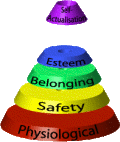
Maslow's hierarchy of needs A friend rhetorically asked me why humans are still putting great resources into researching and developing weapons, space programs and a plethora of "useless gadgets". It's a point well taken, but I feel like there is a part of the thinking process missing. Let me try to explain it.

From the time of the (European) industrial revolution onwards, the old adage that "need is the mother of all invention" became ingrained in our psyche so we either consider that we should put money into researching something because we clearly need it or that we don't clearly need it so we shouldn't fund it. But I really feel like the rules have changed.

Human needs will always exist so there is always the need for ways to manage those needs. But sometimes it is not necessarily clear how need could be filled, especially for complex needs, such as the need for human rights or the need for self actualisation (as Maslow would put it).

In some cases, serendipitous investments in technological pursuits seemingly worthless in terms of humanitarian benefit have accidentally revealed potential for a derivative technology that would benefit people. I see technologies like Google Earth and the world wide web as examples... (I love any excuse to talk about Google Earth!)

We didn't need the WWW or its origins in ARPANET. It was devised to ensure USA world domination would remain intact in the case of strategic bombing of communications lines – hardly a humanitarian benefit unless you are American, but a military benefit.

Nor did We need Google Earth, although no doubt NASA and the USA defence force had some military need for the satellite photos which sustain it. Yet Google Earth is more and more becoming a tool which is not just a cool web-app, apparently useless in terms of bettering humanity, but a technology which turns out to be very helpful indeed. And let's not forget that if it wasn't for the amount of money originally spent on space programs to put the photograph-taking satellites into orbit we wouldn't have Google Earth today!

In such cases it seems like innovation and invention are the parents of totally new ways of thinking and doing things. And, in time have potential to provide genuine humanitarian benefit.

Ages ago, I blogged about a guy in Italy who pinpointed an ancient Roman ruin by observing the area near his house on Google Earth.

Now, two new stories. The first is of a group of farmers near Mumbai using Google Earth to prove they deserved more compensation from the government who acquired their lands for a state government project.

The second is a bit closer to home. Researchers at Wollongong Uni are using Google Earth to spot the sites of mega-tsunamis, possibly caused by kilometre-wide comets hitting the earth. I'm not sure how if is directly useful to humankind, but I sense that being able to predict the likelihood of a mega-tsunami would save a lot more lives than were lost in the recent Aceh tsunami disaster!
The sky is the limit Any more cool uses of Google Earth for human development or generally helping people, please pop a link in the comments.

But just one final comment from me to see what comes out of it...

It could be argued that the world wide web and Google Earth are here today thanks to a consistently generous budget for the US defence department. Imagine if that generous research budget was instead controlled by the Indian department for agriculture, or another country's department for education or department for environment, or the Australian communications and IT department (I wish)... What inventions, serendipitously useful to human development and wellbeing, could we have expected to see by now?

Maslow's hierarchy of needs image courtesy of Hillary.ca blog; Volleyball in the sky image thanks to Hughes.
Categorised as: ,
Technorati Tags: , , , , , , , , , , , ,

Labels: , , , , , , , , , ,